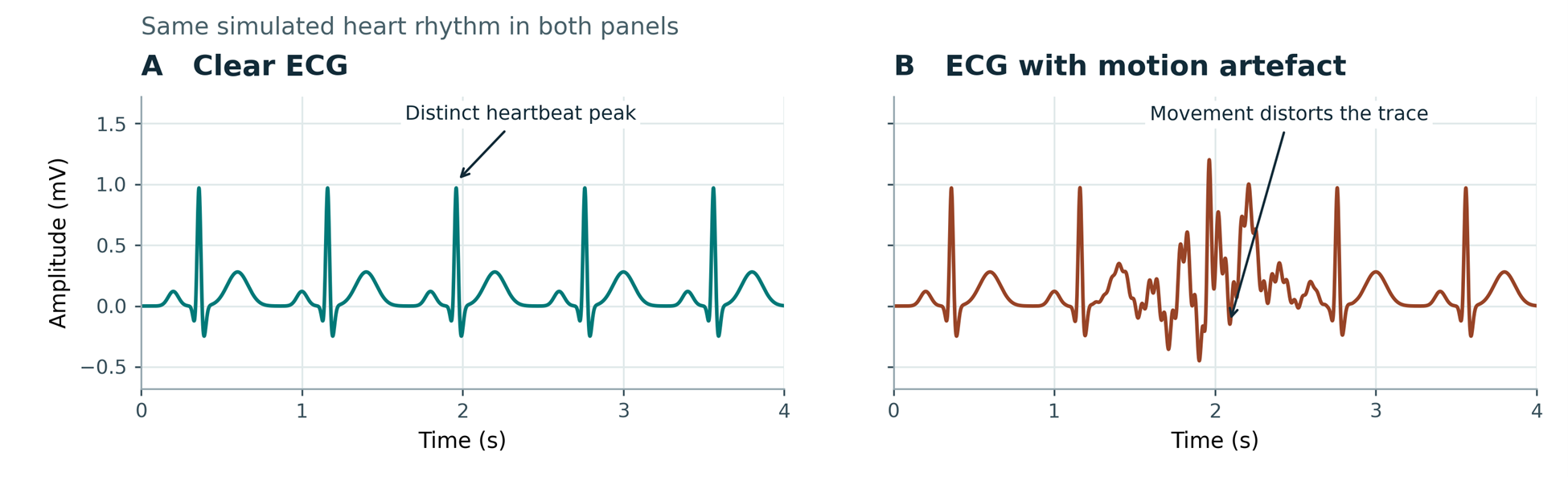


You feel a brief flutter in your chest while carrying groceries. By the time you set the bags down, it has passed. If you’re wearing a portable heart monitor, a clinician can look back at those few seconds. A sudden change in the recording might reflect a change in your heart rhythm, an electrode shifting against your skin, or both. Telling those possibilities apart is one of the challenges of monitoring the heart outside the clinic.
An electrocardiogram, or ECG, records the heart’s electrical activity. A standard ECG captures a brief snapshot. A portable monitor can record for hours or days, giving clinicians a chance to detect changes that come and go as people work, walk and sleep. Ordinary activity also introduces interference. A contracting muscle or an electrode briefly losing contact with the skin can distort the trace. These distortions, called artefacts, can mimic an irregular rhythm or make a genuine change harder to see.
Software can reduce some of that interference. The challenge is knowing how much filtering a recording can tolerate. The spacing between peaks helps a clinician assess the rhythm, and smaller waves carry information about how electrical activity travels through the heart. Too much filtering can flatten one of those waves, leaving a smoother trace with less detail to interpret.

At KNUST, we are studying when to leave a section of ECG alone, when careful filtering can help, and when to flag a section for review. Movement data can provide useful context. If a motion sensor registers a jolt at the same moment the ECG becomes erratic, interference is one possible explanation. A rhythm change can also occur during movement. When the trace remains difficult to interpret, a flag draws the reviewer’s attention to the uncertainty in that part of the recording.
We evaluate the approach beat by beat. We check whether filtering shifts the apparent timing of a beat, changes the shape of a wave, or makes an unusual beat harder to recognise. A filter can improve most of a recording and still obscure the few seconds that matter most. For the person who felt a flutter while carrying groceries, those few seconds may be the reason they wore the monitor in the first place.